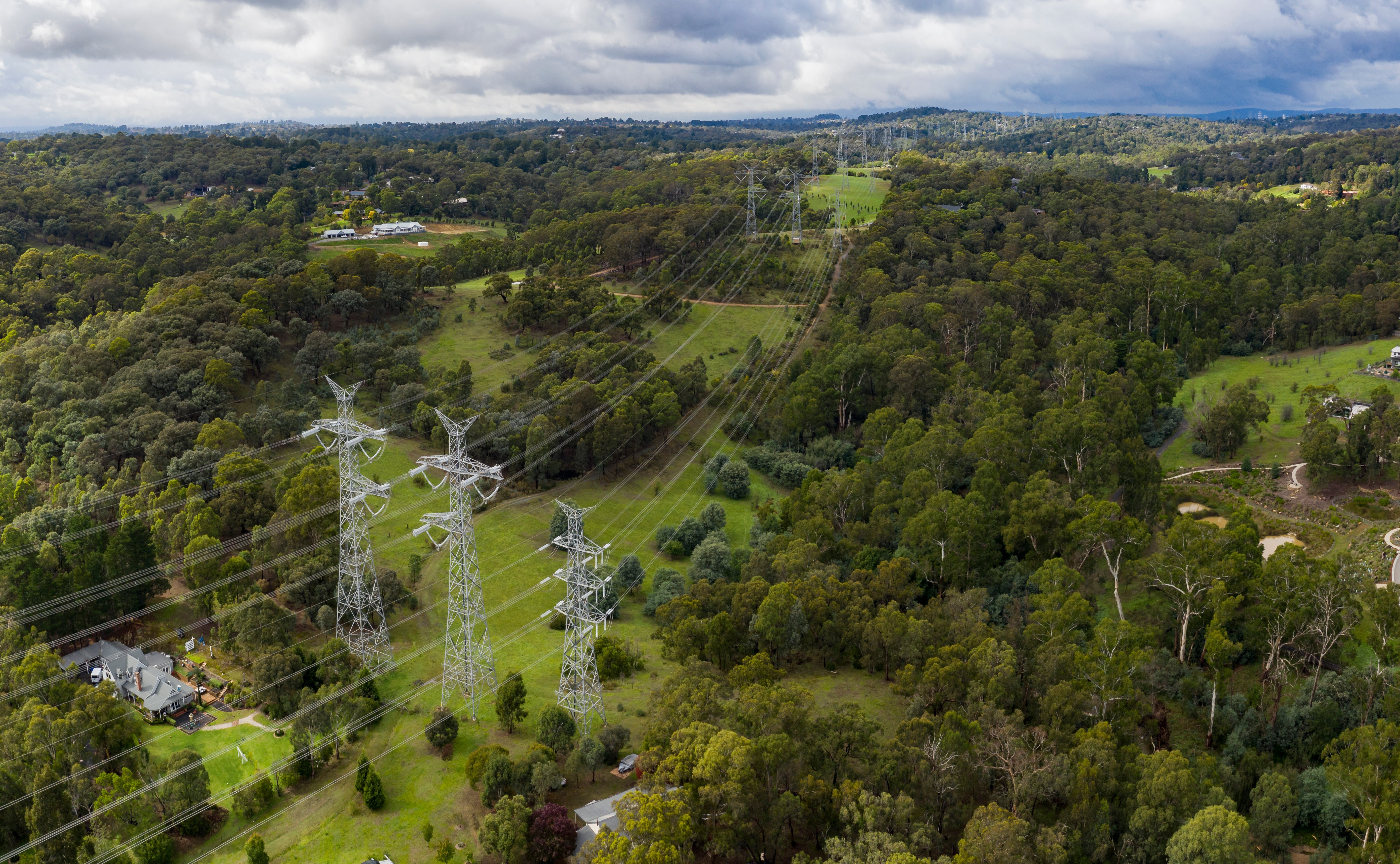




The electricity grid you are connected to was built to do one thing: carry power in one direction, from a small number of large power stations to millions of customers who only ever consumed it. It did that job brilliantly for a century. It was never designed for a country where roughly 4.3 million rooftops generate their own electricity and push the surplus back up the same wires.
That single mismatch sits behind almost every change in Australian energy right now: export limits, falling feed-in tariffs, the smart meter rollout, virtual power plants, the federal battery discount. The grid is being rebuilt from a delivery pipe into something much closer to a network. Here is what is genuinely changing, what is still marketing, and what it means for the system on your roof.
The short version
- Australia has around 28.3 GW of rooftop solar across roughly 4.3 million installations, supplying about 14 per cent of the nation’s electricity.
- The grid was engineered for one-way flow. Two-way flow is the reason export limits, voltage problems and negative daytime prices exist.
- Smart meters become universal across the National Electricity Market by 2030, giving networks visibility they have never had.
- Flexible export limits arrive on the Essential Energy network from late 2026, replacing a flat cap with a limit that moves with local network capacity.
- AEMO’s 2026 Integrated System Plan estimates that orchestrating around half of Australia’s household solar and batteries could avoid up to $5 billion of grid-scale storage investment to 2050.
A grid built for one direction
The modern grid emerged in the late nineteenth century, from Edison’s centralised DC systems, Tesla’s AC innovations and the scale-up that followed. By the middle of the twentieth century it was a genuine marvel of engineering: enormous coal, hydro and gas plants feeding high-voltage transmission lines, stepping down through substations, then out along distribution wires to homes and businesses.
One assumption is baked into every design decision in that system. Power flows downhill, from the substation to the street. Voltage regulation, protection settings, transformer sizing and network planning all take it as given. It is not a flaw. It was the right answer to the problem of the day.
What is straining now is not the wires. It is that assumption.
Four million power stations on the roof
By the end of 2025 Australia had commissioned about 28.3 GW of rooftop solar across roughly 4.3 million installations, with 2.6 GW added during 2025 alone. Rooftop solar supplied 14.2 per cent of the country’s electricity in the second half of that year. Across the National Electricity Market in the first quarter of 2026, renewables supplied 46.5 per cent of generation, a record for any first quarter, while gas-fired generation fell to its lowest quarterly average since 1999.
Storage is following the same curve. AEMO’s 2026 Integrated System Plan counted around 600,000 residential batteries on the National Electricity Market by early 2026, more than half of them installed in the preceding year under the federal discount. The Cheaper Home Batteries Program has since been expanded from an estimated $2.3 billion to around $7.2 billion, with the government expecting it to support more than two million battery installations and roughly 40 GWh of storage by 2030.
The consequence shows up at street level. On a sunny midday in a high-solar street, power flows backwards up the low-voltage feeder, local voltage rises, and inverters throttle or trip to protect themselves. That is why export limits exist. Essential Energy already has more than 290,000 customers generating rooftop solar and expects up to half of its customers to have it by 2040. On its network, embedded generation systems generally carry a fixed export limit of 5 kW, for single-phase and three-phase connections alike, and a lower limit may apply in some areas. It is not a penalty. It is a one-way network reaching the edge of what it was built to do.
From a pipe to a network
The comparison people reach for is the telephone system, and it is a useful one. Old circuit-switched telephony dedicated a physical path to every call. Packet switching broke messages into pieces, gave every device an address, and let software decide the route. Capacity stopped being a question of laying more copper and became a question of using the copper you already had far more intelligently.
Electricity cannot be packetised the way data can. Electrons are not addressable, and the physics of an AC network is unforgiving. But the control layer above the wires can absolutely work that way. Give every inverter, battery and charger an address and a communications channel, and the network operator can shape flows in real time rather than setting one conservative limit and hoping for the best.
That is the honest version of the “energy internet” idea. The routing metaphor applies to information and control, not to the electricity itself. The distinction matters, because it is exactly where a great deal of energy marketing quietly overpromises.
What is actually being built, right now
None of the following is speculative. Each piece has a rule, a date and a regulator’s name attached to it.
1. Smart meters everywhere by 2030
In November 2024 the Australian Energy Market Commission made a final rule requiring smart meters for all customers across the National Electricity Market by 2030, with the accelerated rollout commencing in December 2025. Interval consumption data and power quality data give networks a view into the low-voltage grid they have simply never had. You cannot manage what you cannot see, and until recently distributors could not see most of it.
2. Flexible exports on the Essential Energy network
From late 2026, Essential Energy will offer flexible export limits for new and upgraded systems up to and including 200 kW, at the same time as the NSW Emergency Backstop Mechanism commences. Instead of one fixed cap, your limit moves through the day with available network capacity, typically ranging from 1.5 kW to 10 kW per phase.
Two things are worth separating here. Being backstop enabled will be compulsory for new and upgraded systems: from late 2026 installers must fit inverters compliant with the CSIP-AUS standard, pass a connectivity test and register the system through the NSW CER Installer Portal. Taking a flexible export limit is the optional upside sitting on top of that, and you can choose a low fixed limit instead. Existing rooftop systems are not affected.
Both depend on a working internet connection at the property. Where there is no reliable connection, the system must still be CSIP-AUS compliant, and a low fixed export limit may apply until one becomes available. In this region, that is not a trivial detail.
3. Orchestration, and what it is worth
AEMO’s 2026 Integrated System Plan, released in June 2026, put households at the centre of the story for the first time. It found that orchestrating around half of the country’s collective household solar and battery capacity could avoid up to $5 billion in additional grid-scale storage through to 2050. It also found that a household with solar and a battery reduces average evening peak grid demand by roughly 1 kW compared with a solar-only household, which lowers wholesale prices at peak and benefits every customer, including those without solar.
4. The market plumbing
Less visible, but arguably the most important piece. New AEMC rules, the majority of which take effect on 1 November 2026, allow a household’s flexible assets to be separated from its passive load and recognised properly in the wholesale market. AEMO is also building a national Consumer Energy Resources Data Exchange to move information between networks, retailers and aggregators. Rules and data standards are what turn a good idea into an actual market.
What it means for the system on your roof
Inverter choice now matters for more than efficiency. Low-voltage inverters have had to meet AS/NZS 4777.2:2020 since February 2025, and from late 2026 new and upgraded systems in NSW will also need a software communications client compliant with CSIP-AUS. The Clean Energy Council publishes the list of approved inverters, and hardware that is not on it will leave you sitting on a low fixed cap. Every brand on our brands page is assessed with this in mind.
Storage has shifted from optional to structural. With export ceilings in place and feed-in tariffs at a few cents, the value of your solar is increasingly in what you use yourself. Every kilowatt-hour you consume at home is worth the full retail tariff, commonly 25 to 35 cents, against a feed-in rate of well under 10 cents. A battery converts curtailed midday surplus into evening supply. It also means blackout backup, which in this region is rarely a theoretical concern. Installed with new or existing solar, a battery can still qualify for the federal discount, although the rules changed on 1 May 2026 and the benefit now tapers on larger systems. You can read the detail on our Federal Battery Rebate page. Our Sigenergy article covers one platform built for exactly this kind of staged growth.
Orchestration is a choice, not an obligation. Virtual power plant offers vary enormously in what they pay, how much control they take and how easily you can leave. Read the terms, not the headline figure, and judge the hardware on what it saves you today rather than on a promised future revenue stream.
Design for the load you will have, not the load you have. An EV, a heat pump hot water system or a workshop changes the arithmetic considerably. Sizing solar and storage around a five-year view is far cheaper than retrofitting twice.
Where the honest limits are
A grid full of remotely controllable devices is also a much larger attack surface, and cyber security standards are still catching up with the pace of deployment. Vehicle-to-home and vehicle-to-grid are real, but remain gated by vehicle compatibility and network approvals. Peer-to-peer energy trading has been discussed for well over a decade, and the hard part has never been the technology; it is settlement, network charges and consumer protection. And every household connected to a distribution network is still dependent on that network’s condition, which is one reason genuinely remote properties are often better served by a properly designed off-grid system.
We have watched a lot of confident predictions come and go since 1987. The current direction of travel is well supported by rules and money, which is more than could be said for several previous waves. It is still worth buying hardware on what it does for you now.
Grid evolution FAQs
Why is my solar export capped?
Because the low-voltage network in your street was designed to carry power in one direction. When many homes export at once, local voltage rises and equipment protects itself by throttling or disconnecting. Export limits keep voltage inside the legal range. Your limit is set by your distributor, not by us or by your retailer.
What are flexible export limits, and when do they reach the Northern Rivers?
A flexible limit changes through the day according to how much capacity the local network has, rather than staying fixed. Essential Energy plans to offer them for new and upgraded systems up to 200 kW from late 2026, at the same time as the NSW Emergency Backstop Mechanism commences. Taking a flexible limit is optional, and you can stay on a low fixed limit instead. Being backstop enabled is not optional for new and upgraded systems, and requires a CSIP-AUS compliant inverter and an internet connection. Existing systems are not affected.
Do I have to get a smart meter?
Under the AEMC’s rule, all customers in the National Electricity Market move to smart meters by 2030, and the accelerated rollout began in December 2025. If you have had solar installed in recent years, or you are on a time-of-use tariff, you almost certainly already have one. Metering is arranged through your retailer.
Will my system still work in a blackout?
Only if it is designed to. A standard grid-connected solar system shuts down during an outage for the safety of line workers. To keep circuits running you need a battery and inverter configured for backup, with the essential circuits identified in advance. We design those circuits around what actually matters to you: fridge, lights, communications, water pump.
Is joining a virtual power plant worth it?
Sometimes. It depends on the payment offered, how much of your battery the operator can call on, whether your own backup needs are protected, and how easily you can exit. Treat any VPP income as a bonus on top of a system that already stacks up on self-consumption alone.
Does all this mean I should go off-grid?
For most connected properties, no. A grid connection with solar, storage and backup is usually the lower-cost and lower-maintenance answer, and it lets you sell your surplus. Off-grid makes sense where connection costs are high, supply is poor or the site is genuinely remote. We build both, so we have no reason to steer you towards one over the other.
Build for the grid we are heading into
The rules changing between now and 2030 will decide how much your system is allowed to export, what your battery is worth and whether your hardware can participate at all. Those choices are made at design and installation, not afterwards.
Talk to Australia’s longest-serving solar team. We will look at your usage, your site, your distributor and your plans, then give you a straight answer on what to build. Get a quote or call us at 02 6689 1430.
This article is general information only and is current at the time of writing. Figures are drawn from published Clean Energy Council, Clean Energy Regulator, AEMO, AEMC and Essential Energy material and may change. Export limits, connection rules, program timing and rebate eligibility depend on your distributor and on the rules in force at your installation date, and are not guaranteed. Savings depend on your system design, site and usage. We would be glad to confirm exactly what applies to your property.